How to hit harder in tennis without swinging harder
Hit harder without swinging harder.
See it, eight instants at a time.
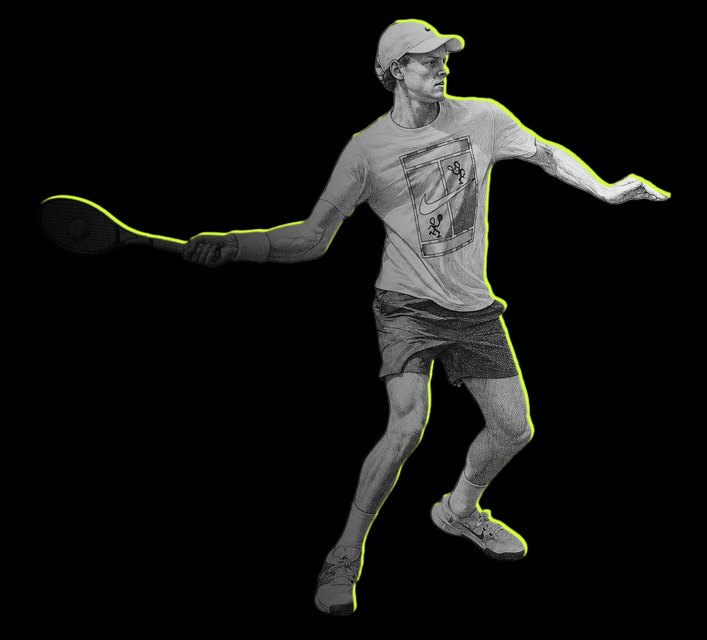
Every frame is traced from real match footage, so you see the shape of the stroke, not a drawing of an idea.
Key facts
- 1
On the serve, internal rotation of the shoulder is the biggest single contributor to racquet speed, about 40%.
Elliott, "Biomechanics and tennis", British Journal of Sports Medicine, 2006
- 2
Other serve work puts the shoulder's internal-rotation share as high as about 54%.
Tanabe
- 3
On the forehand, shoulder horizontal flexion contributes about 45 to 48% of racquet speed and elbow extension about 17 to 21%. Elite forehand racquet speed at impact is 21.8 to 22.6 m/s.
Reid et al., Sensors, 2022
- 4
In a 2024 serve study, slow and fast serves were measured at 34.89 and 45.43 m/s.
Gorce & Jacquier-Bret, Frontiers, 2024
- 5
The ball is on the strings for only about 4 ms, too short to push it.
Why it works
You can't push the ball, because it's gone in about 4 ms. You can push the court. The court pushes back, the hips turn that push into rotation, the trunk uncoils on top of the hips' speed, the arm inherits the trunk's, and the racquet, the lightest link, gets all of it last.
Each link peaks, then brakes, and the braking is what throws momentum outward. That's why a short, stiff finish costs you speed: it can't brake the links nearer the body properly.
Speed and energy live at opposite ends of the chain. The racquet is the fastest thing at contact, but the legs supplied the most energy. If the arm fires first, you're arming the ball and throwing away everything below it.
The line to say on court“The arm is last.”
Drill: The chain count
15 min · alone- Shadow-swing 20 forehands, counting out loud: legs, hips, torso, arm, racquet.
- Drop-feed 20 forehands starting from a deep knee bend. Let the legs start the swing.
- Count how many land past the service line without you trying harder.
More drills like this: forehand
Faults and fixes
Questions players ask
Does tennis power come from the arm?
Mostly not. The arm is the last link in the chain. On the serve, the legs supply an estimated half or more of the energy, and the arm inherits speed built by the legs, hips and trunk.
What is the kinetic chain in tennis?
It's the sequence of body segments, legs, hips, trunk, arm and racquet, that fire in order so each one adds speed to the next.
Which part of the body is fastest at contact?
The racquet. But the legs supplied the most energy. Speed and energy sit at opposite ends of the chain.
Do the links have to fire in a strict order?
Legs to racquet is a strong rule of thumb, not a law. Sensor work on pro servers finds how much each link contributes can matter as much as strict order.
What this doesn't cover
Proximal-to-distal order is a strong heuristic, not a law. Sensor work on pro servers finds the size of each link's contribution can matter as much as the order. The share of energy from the legs is an estimate, and the percentages differ between studies.
Sources
- Elliott (2006), "Biomechanics and tennis", British Journal of Sports Medicine
- Reid, Whiteside & Elliott (2006), Journal of Sports Sciences
- Kovacs & Ellenbecker (2011), Sports Health
- Reid et al. (2022), Sensors
- Gorce & Jacquier-Bret (2024), Frontiers