How to hit a modern topspin forehand
Build the forehand they can't read.
See it, eight instants at a time.
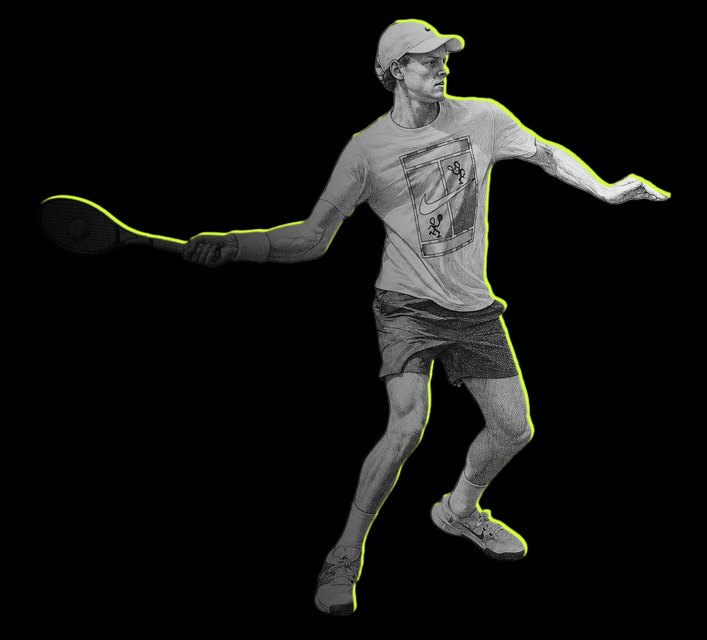
Every frame is traced from real match footage, so you see the shape of the stroke, not a drawing of an idea.
Key facts
- 1
Rafael Nadal's forehand is widely reported to spin at roughly 3,200 rpm on average and nearer 5,000 rpm at its most violent, against about 1,800 rpm for Pete Sampras. These figures are still being checked against the original measurements.
Yandell / Tennis Warehouse University spin measurements, as widely reported
- 2
Forehand topspin rises with the racquet's upward speed before impact, about 6.6 m/s in the study, and a more closed face, with impact angles of 70 to 85 degrees and a mean near 80, r² ≈ 0.90.
King et al., Journal of Sports Science & Medicine, 2017
- 3
The sub-elite players in that study averaged 969 rpm of topspin, so pros roughly triple it.
King et al., Journal of Sports Science & Medicine, 2017
- 4
About a quarter of racquet speed at impact comes from the shoulder and three quarters from the arm and hand, because the legs and trunk delivered the momentum first.
After Reid, Whiteside & Elliott
Why it works
The forehand is the kinetic chain turned on its side. The ground pushes back, the hips open while the shoulders hang back, and the trunk uncoils on top of the speed the hips gave it. The racquet, relaxed enough to lag, is the last link.
Contact has to happen where the racquet head is still accelerating, which is out in front. Hit late and the chain has already fired, so the racquet is slowing down when it meets the ball.
Spin is the point. In one generation the defining forehand didn't learn to hit twice as hard. It learned to spin nearly twice as fast, which lets you swing out and still land the ball. Your grip moves contact up and down, but out in front isn't negotiable.
The line to say on court“Meet it out front.”
Drill: Out front
15 min · alone- Put a cone a racquet-length in front of your front foot.
- Drop-feed 20 forehands and make contact above the cone every time.
- Count the clean ones. Beat that number next session.
More drills like this: forehand, practise alone
Faults and fixes
Questions players ask
Where should I make contact on a forehand?
About a racquet-length in front of your front foot. Grip changes how high you meet the ball, not whether it's out front.
Why does my forehand feel late?
Usually the turn and split came too late, so the chain has already fired and the racquet is slowing at contact. Turn earlier and meet the ball in front.
Do you use your wrist to put topspin on a forehand?
No. Rolling the wrist kills the brush and sprays contact. Topspin comes from a swing path that travels up into the ball and a more closed face.
How much topspin do pros hit on the forehand?
Nadal's forehand is widely reported at roughly 3,200 rpm on average and nearer 5,000 at its peak, with Sampras at about 1,800, though those figures are still being checked. Sub-elite players in one study averaged 969 rpm.
What this doesn't cover
The checkpoints, contact position and swing path behind this guide come from one tracked swing and illustrate the mechanism. They aren't population averages. The pro spin figures are widely reported measurements, not a controlled study, and are still being checked against the original sources.
Sources
- King et al. (2017), Journal of Sports Science & Medicine: forehand topspin
- Reid, Whiteside & Elliott (2006), Journal of Sports Sciences
- Elliott (2006), British Journal of Sports Medicine
- Yandell / Tennis Warehouse University: spin measurements