How to get racquet lag on your forehand
Let the racquet fall behind. Then let it go.
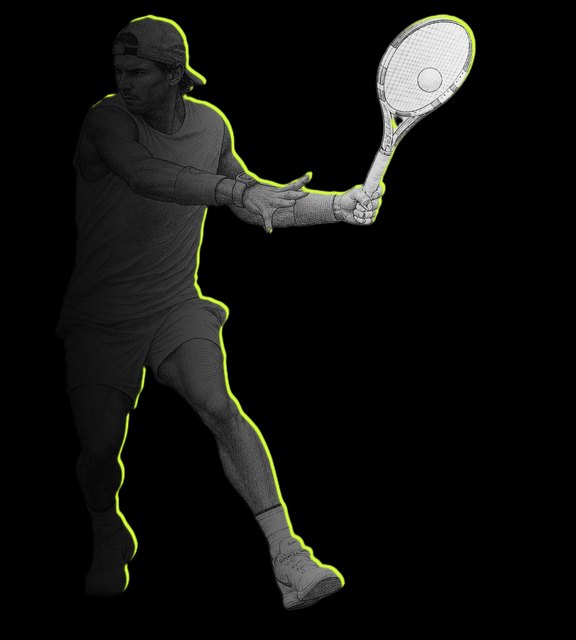
See it, eight instants at a time.
Every frame is traced from real match footage, so you see the shape of the stroke, not a drawing of an idea.
Key facts
- 1
In elite forehands, shoulder horizontal flexion contributes 45 to 48% of racquet speed at impact, elbow extension 17 to 21%, and forearm pronation between −2 and −0.9%.
Reid et al., Sensors (2022)
- 2
Elite forehand racquet speed at impact was 21.8 to 22.6 m/s in a study of six elite players wearing 17 motion sensors.
Reid et al., Sensors (2022)
- 3
Racquet lag works as borrowed elastic energy, stored as the racquet trails the hand and released into the ball.
Elliott, British Journal of Sports Medicine (2006)
- 4
The forearm rotation in the wiper finish shapes face angle and spin, not pace.
Why it works
Watch a pro forehand in slow motion and the racquet looks left behind. That lag is power stored a split second before it fires. The trunk turns forward, a relaxed wrist lets the racquet trail, and the head loads like the tip of a whip while the hand runs ahead.
Then the hand slows, and everything the body built goes into the lightest link. You don't add power at the end of the chain. You release it. Force the wrist and you stiffen the whip into a stick.
It isn't a wrist snap either. The shoulder and elbow make the speed spike at contact. Lag isn't something you do. It's what happens when the body fires and the hand stays soft.
The line to say on court“Let it fall behind. Then let it go.”
Drill: Drop and let go
15 min · alone- Hold the racquet with your thumb and two fingers. Make twenty shadow forehands and feel the head fall behind your hand as your hips turn.
- Take a full grip, held loose. Hit twenty drop-feed forehands. Listen for the sound at contact, not before it.
- Film from behind. Count the swings where the racquet head is visibly behind your hand as your chest starts to face the net.
More drills like this: forehand, practise alone
Faults and fixes
Questions players ask
Should I snap my wrist on the forehand for power?
No. In elite forehands, forearm pronation adds essentially nothing to racquet speed. The shoulder and elbow make the speed, and a forced wrist stiffens the chain.
Where does forehand power come from?
From the body turning while a relaxed arm lets the racquet trail, then release. In elite players the shoulder contributes about 45 to 48% of racquet speed and elbow extension about 17 to 21%.
Does the windshield-wiper finish add speed?
No. The forearm rotation in the wiper is about face angle and spin, not pace.
How do I know if I have racquet lag?
Film from behind. If the racquet head is visibly behind your hand as your chest starts to face the net, you have lag.
What this doesn't cover
How much of the release is passive and how much is actively timed is contested among coaches. The sensor numbers come from six elite players and may not transfer to club players. The advice explains where speed comes from, not how to fix every forehand.
Sources
- Reid et al., "Evaluation of Upper Limb Joint Contribution to Racket Head Speed", Sensors (2022)
- Elliott, British Journal of Sports Medicine (2006)