How to use hip and shoulder separation for a heavier forehand
Open the hips. Hold the shoulders.
See it, eight instants at a time.
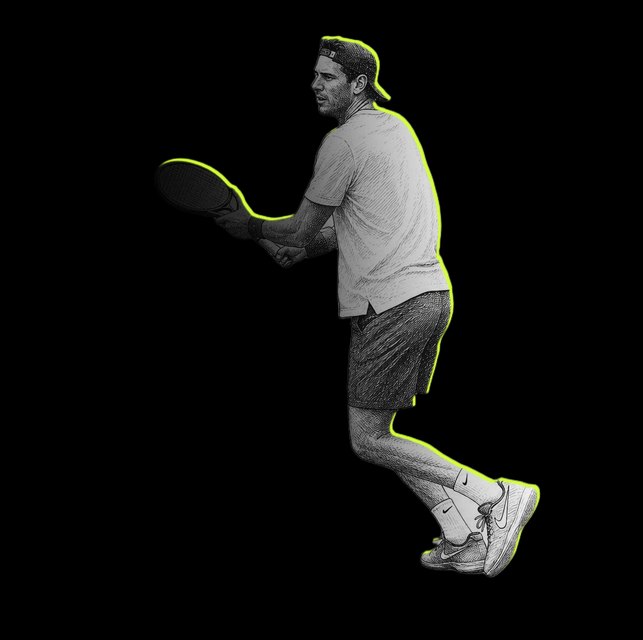
Every frame is traced from real match footage, so you see the shape of the stroke, not a drawing of an idea.
Key facts
- 1
In serve data, trunk axial rotation correlates with racquet speed at r = 0.83 in the loading phase and r = 0.76 in the acceleration phase.
Gorce & Jacquier-Bret, Frontiers, 2024
- 2
A muscle-tendon unit stretched fast stores elastic energy and trips a reflex, so the contraction that follows is stronger than one from rest.
- 3
The coaching-blog claim that widening separation from 20 to 35 cm adds 15 to 20 mph is a heuristic, not a lab result.
- 4
The strongest peer-reviewed support for separation is a correlation in serves, not a forehand dose-response.
Why it works
Turn the shoulders and hips together and you've moved, but nothing is loaded. Turn them together, then let the hips go first while the shoulders hold, and the trunk is stretched like a wound spring.
Stretch a muscle-tendon unit fast and it stores elastic energy and trips a reflex, so the contraction that follows is stronger. The shoulders then uncoil on top of the hips' speed. That's the summation, made of a gap.
Most amateurs turn hips and shoulders as one block and never load the spring. More isn't always better, though. Over-rotation is a fault and a back-injury risk, so aim for a good coil, not the biggest one.
The line to say on court“Hips lead. Shoulders wait.”
Drill: Hold the shoulders
15 min · alone- Tie a band to the fence at hip height. Do twenty reps: open the hips against the band while the shoulders hold, then release.
- Shadow twenty forehands with your off-hand on the throat of the racquet through the turn. Count "hips, shoulders" out loud.
- Drop-feed twenty forehands with a phone filming from behind you. Count the swings where your belt buckle turns before your chest.
More drills like this: forehand, practise alone
Faults and fixes
Questions players ask
Does a bigger backswing give you a more powerful forehand?
No. Backswing length isn't a speed source. The coil between hips and shoulders is, so don't swing back further, coil more.
Should my hips or shoulders turn first on a forehand?
Turn them together on the unit turn, then fire the hips first while the shoulders hold. If your chest and belt buckle face the net at the same moment, you never loaded anything.
Can you over-rotate on a forehand?
Yes. Hips that fly open early spray the ball and put load on the back. Over-rotation is a fault and a back-injury risk.
What is the X-factor in tennis?
It's the angle between the line of the hips and the line of the shoulders during the coil, with the pelvis leading and the shoulders trailing.
What this doesn't cover
The strongest peer-reviewed support is a correlation in serves, not a forehand study showing that more separation gives more speed. More isn't always better, and over-rotation is a back-injury risk. There's a useful range, not a ceiling to chase.
Sources
- Gorce & Jacquier-Bret (2024), Frontiers: trunk rotation and racquet speed in the serve