How to toss the ball for a tennis serve
Toss to one spot. Serve three ways from it.
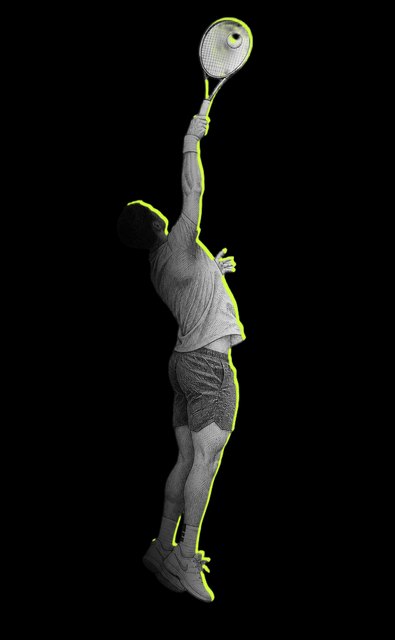
See it, eight instants at a time.
Every frame is traced from real match footage, so you see the shape of the stroke, not a drawing of an idea.
Key facts
- 1
By one physics estimate, a ball falling about 3 ft at about 9.5 mph already carries roughly 780 rpm of topspin relative to the racquet at contact, potentially more than half a kick serve's topspin.
Tennis Warehouse University, Physics of the Tennis Kick Serve
- 2
Serve contact sits near 150 % of the server's standing height.
- 3
A common target is 17 of 20 tosses landing on a towel placed at the ideal contact spot.
- 4
A higher toss gives the ball more drop and more timing variance, without adding margin.
Why it works
The ball is a projectile from the moment it leaves your hand. Its drop time is fixed by how high it went, and where it is at contact is fixed by where you let go and how the arm was moving. Contact height, spin axis, placement and whether the returner can read you are all set at release. That's why the fix is at the hand, not at the racquet.
Release from a straight, locked arm at eye level. Tossing and reaching up as if to catch it keeps the arm up and the chest open. An over-the-head toss arches the back and lets the strings brush up from 7 to 1 for the kick, but it can't produce a flat bomb. Keep the toss the same whatever the target: if it moves with the target, the returner reads the target.
The line to say on court“Same hand, same spot, same height. Only the strings change.”
Drill: Toss and catch
10 min · alone or with a partner- Lay a towel at the ideal contact spot, slightly in front and into the court. Toss with a straight arm, release at eye level and let the ball fall. Twenty tosses. Count the ones that land on the towel.
- Toss and reach to catch the ball at full extension without moving your feet. Twenty tosses.
- With a partner, toss and serve. Your partner calls T, body or wide after the ball is up. Nine serves.
More drills like this: serve, practise alone, beginners
Faults and fixes
Questions players ask
How high should I toss for my serve?
To the peak of your reach. A higher toss gives more drop and more timing variance, not more margin.
Where should I toss for a kick serve?
For a right-hander, further over the head, so the back arches and the strings can brush up from 7 to 1.
Why does my second serve keep hitting the net?
Often it's a release problem, not a swing problem. Tossing higher adds variance and tossing further forward flattens the arc. Toss over the head so the brush sends the ball up.
Should my toss change for different targets?
No. If the toss moves with the target, the returner reads the target. Keep one toss and aim with the strings.
What this doesn't cover
How much toss variation pros actually tolerate hasn't been measured in any source used here. Toss positions are for right-handers and vary by coaching school, so treat them as ranges, not absolutes.
Sources
- Tennis Warehouse University, Physics of the Tennis Kick Serve
- Sakurai et al. (with Cross): toss differences between slice and kick serves
- Kovacs & Ellenbecker (2011): the stages of the serve
- ITF coaching: the toss-and-catch progression