How to hit flat, slice and kick serves
One swing, three balls. Tilt the axis and the bounce changes.
See it, eight instants at a time.
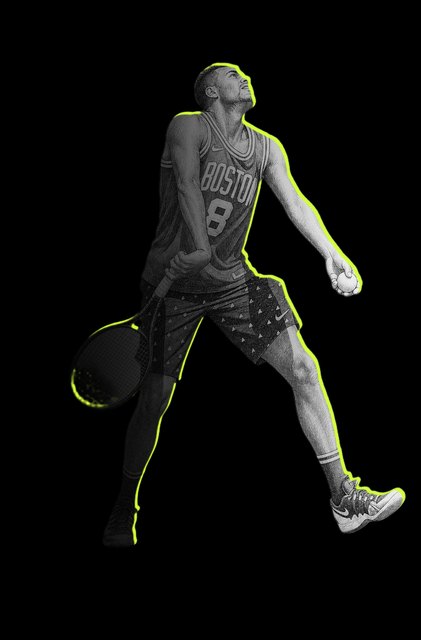
Every frame is traced from real match footage, so you see the shape of the stroke, not a drawing of an idea.
Key facts
- 1
A kick serve's spin axis sits about 10–30° off vertical, so it's mostly sidespin, with total spin of 3,200–4,500 rpm.
Tennis Warehouse University, Physics of the Tennis Kick Serve
- 2
At contact on a kick serve the racquet rises only about 5°, against about 30° for a topspin groundstroke.
Tennis Warehouse University, Physics of the Tennis Kick Serve
- 3
A kick serve crosses the baseline at 5–6 ft.
Tennis Warehouse University, Physics of the Tennis Kick Serve
- 4
After the bounce the court supplies the upward rebound while the topspin force keeps pulling the ball down, so "more topspin means a higher bounce" isn't a safe rule.
Cross, The kick serve in tennis
Why it works
Spin is the Magnus force with a direction. The topspin part pushes the ball down, so you can clear the net by more and still land it. The sidespin part curves it. Tilting the spin axis is how one swing makes three different balls.
After the bounce the court supplies the upward rebound, and the spin force keeps pulling down during the next flight. What happened before contact helped set the rebound, and the forces after it keep changing the path. That's the kick-serve paradox: a ball that pulls down still jumps up.
Nothing else about the motion needs to change: contact stays at the top of your reach with the arm straight. Only the racquet's path through the ball changes, and that's the disguise.
The line to say on court“Same swing. Different clock hand.”
Drill: The clock
12 min · alone- Put a marker on the back fence at your shoulder height and take a basket of balls.
- Hit ten flat serves to the deuce T, brushing from 6 to 12.
- Hit ten slice serves to the deuce wide corner, brushing around the outside of the ball.
- Hit ten kick serves to the ad backhand corner, brushing from 7 to 1. Count the bounces that pass the marker.
More drills like this: serve, practise alone
Faults and fixes
Questions players ask
Which second serve should I hit to a right-hander's backhand from the ad court?
Usually the kick. It climbs into the backhand shoulder they don't want it on. A right-hander's slice wide from the ad side tends to curve toward their forehand, and a flat serve has the lowest margin.
Is a kick serve topspin?
Mostly sidespin. Its axis sits about 10–30° off vertical, with a topspin part that pulls it down over the net.
Why does my kick serve skid instead of jumping?
You're probably hitting it at full pace, and speed steals brush. Use a slower arm and a faster brush.
How do you disguise your serve?
Keep the motion the same and change only where the strings brush the ball: 6 to 12, around the outside, or 7 to 1.
What this doesn't cover
The spin and bounce numbers here are for the kick serve only. Reliable ranges for flat and slice spin, their bounce heights and kick serve speeds still need sourcing. Ball-flight model heights are illustrations, not predictions for any serve, and spin can't be read from ordinary video. Placement advice assumes a right-handed server.
Sources
- Tennis Warehouse University, Physics of the Tennis Kick Serve
- Cross, The kick serve in tennis