How to serve in tennis: the service motion step by step
Serve from the ground up. Let the arm arrive last.
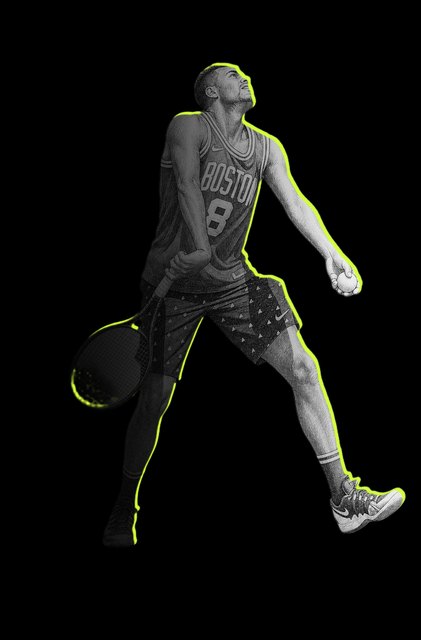
See it, eight instants at a time.
Every frame is traced from real match footage, so you see the shape of the stroke, not a drawing of an idea.
Key facts
- 1
Legs and trunk supply about 51–55 % of the serve's kinetic energy.
Kovacs & Ellenbecker, Sports Health, 2011
- 2
By one estimate, shoulder internal rotation supplies about 40 % of racquet-head speed at impact.
Elliott, BJSM, 2006
- 3
At the trophy position, knees load to about 90–115° and the shoulder rotates back past 170°.
- 4
In one small study, faster servers showed 1,604 vs 1,311 °/s of shoulder internal rotation and 45.4 vs 34.9 m/s of peak racquet speed.
Gorce & Jacquier-Bret, Frontiers, 2024
- 5
Elite men make contact near 150 % of their standing height, and racquet-head speed at impact runs 38–47 m/s across studies.
- 6
Recorded serve speeds at the top of the list include Groth 263.4 km/h, Isner 253.0 km/h and Roddick 249 km/h.
Wikipedia, fastest recorded serves
Why it works
The serve adds up speed from a standing start. The legs push the ground, the hips and trunk uncoil, the shoulder lays the racquet back and then rotates it through, and the forearm turns the face square at the last moment. Each link peaks and slows so the next one can go faster.
The motion runs through eight stages: start, release, loading, cocking, acceleration, contact, deceleration and finish. The racquet drop is the key stop. The racquet falls edge-on before it rises, which stores stretch in the shoulder for the throw.
The wrist doesn't snap. The forearm pronates, mostly after the face passes the ball. So if you feel the effort in your forearm, the chain fired out of order. Arming the serve overloads the shoulder and caps your speed, and the fix sits lower in the body than the pain.
The line to say on court“Legs load it. Shoulder throws it. The wrist just arrives.”
Drill: Kneel, stand, launch
10 min · alone- Kneel on your back knee at the baseline with a continental grip. Serve ten balls into the box using only the upper-body throw, with the racquet edge-on into the drop.
- Stand with your feet still and no leg drive. Hit ten balls with the same throw.
- Use your full motion for ten balls. Land on your front foot inside the baseline.
More drills like this: serve, practise alone, beginners
Faults and fixes
Questions players ask
Should I snap my wrist on the serve?
No. The wrist snap is a myth. The forearm pronates, mostly after the racquet face passes the ball.
Why does my shoulder hurt when I serve?
One common cause is arming it. Without a leg load the shoulder does the legs' job, which overloads it and caps your speed. Rebuild the knee load and racquet drop first.
Where does serve power come from?
Mostly from the legs, trunk and shoulder rotation. Legs and trunk supply about 51–55 % of the kinetic energy, and shoulder internal rotation about 40 % of racquet-head speed, measured in different ways by different studies.
Will tossing higher give me a faster serve?
No. A higher toss adds timing variance but no speed.
What this doesn't cover
The percentages come from different studies using different metrics, energy in one and racquet speed in the other, so they don't add up. The fast-versus-slow numbers come from a small sample and show correlation. Single-camera video shows the sequence and shape of the serve, not joint speeds.
Sources
- Kovacs & Ellenbecker, Sports Health (2011)
- Elliott, British Journal of Sports Medicine (2006)
- Reid, Whiteside & Elliott, Journal of Sports Sciences (2006)
- Gorce & Jacquier-Bret, Frontiers (2024)
- Wikipedia: fastest recorded tennis serves