How to return a fast serve in tennis
Block the first. Swing at the second.
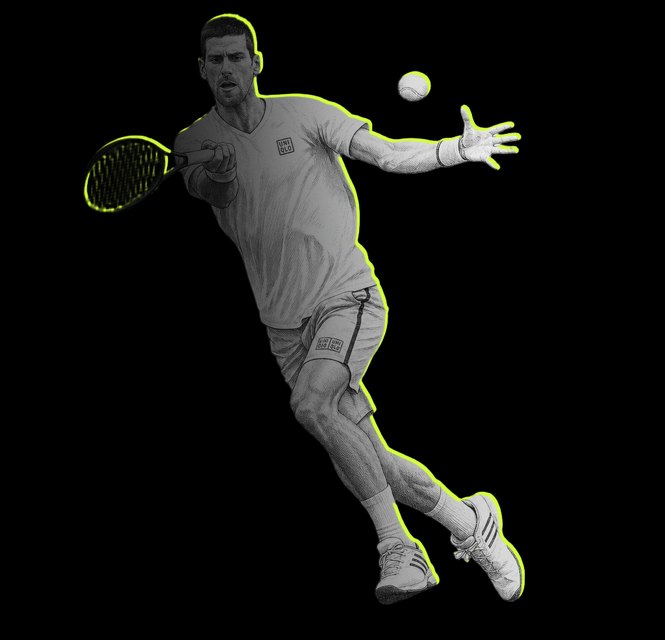
See it, eight instants at a time.
Every frame is traced from real match footage, so you see the shape of the stroke, not a drawing of an idea.
Key facts
- 1
A 200 km/h serve reaches the returner in about 333 milliseconds.
Farrow, The Conversation
- 2
Novak Djokovic wins about 55 % of second-serve return points and converts about 44 % of break points.
ATP Beyond the Numbers, Jan 2026
- 3
Djokovic is the highest-rated career returner in the ATP's four-stat return composite.
ATP Beyond the Numbers, Jan 2026
- 4
Andre Agassi's return used a compact backswing, a long forward swing and contact on the rise, described as virtually the same motion as a rally shot.
TennisOne, Agassi's return
Why it works
A fast first serve doesn't leave time for a full backswing. So you don't take one. A short, firm backswing with a stable face redirects the ball's own energy back, the same principle as a volley. The pace is borrowed, not made.
Against a second serve there is time. Step in and swing, and the swing adds your own pace and shape. Block and full swing aren't two different ideas. They're one continuum, and the clock decides where you sit on it.
The chip is the third answer. It's an open-faced, continental underspin block that absorbs pace, stays low after the bounce and lets you come forward.
The line to say on court“Short and firm on the first. Let it go on the second.”
Drill: Block only, then swing
12 min · with a partner- Take ten first serves from your partner. Use zero backswing and punch each return deep through the middle. Count the returns that land past the service line.
- Take ten second serves. Step in and take a full swing to a cone in a deep corner.
- Have your partner mix first and second serves at random. Call out block or swing before contact.
More drills like this: return
Faults and fixes
Questions players ask
Should I block or swing on the return of serve?
Block a fast first serve and swing at a second serve. Decide which before the ball is served.
Is a block return passive?
No. It's the most efficient way to send a 200 km/h serve back deep. You borrow the server's pace instead of making your own.
What is a chip return?
An open-faced, continental underspin block. It absorbs pace, stays low after the bounce and lets you come forward, which suits a fast court or a plan to attack the net.
Where should I aim a blocked return?
Deep down the middle. That starts the point even.
What this doesn't cover
The idea that the block borrows the ball's energy is a principle, not a measurement. There's no return-speed data or restitution figure for a blocked return behind it. The timing numbers are for a 200 km/h serve, and your own cut-off between block and swing depends on your reactions.
Sources
- ATP Beyond the Numbers (Jan 2026): return leaderboard and four-stat composite
- Farrow, The Conversation: reaction time on the return of serve
- TennisOne: Andre Agassi's return
- Tennis Instruction: return technique