Novak Djokovic's backhand
Traced frame by frame from real footage.
Djokovic's two-handed backhand isn't a heavy ball, but it's one of the most reliable ever. Over five years of hard-court charting only 6.8 % of his backhands were unforced errors, against 9.4 % on average. Analysts point to a wrist that barely moves through contact, trading some spin for control.
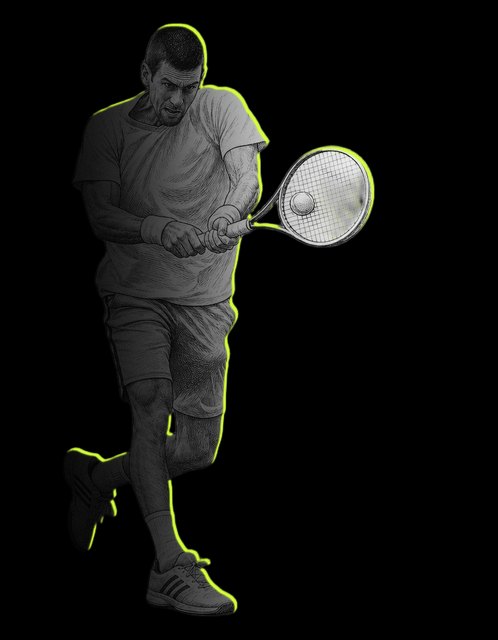
- 1The unit turn coils the shoulders with both hands on the grip, and the racquet rises high behind the shoulder.
- 2The racquet head drops below the hands, then comes through from below the ball with the hands leading.
- 3Contact is out in front with both arms driving through, before a full wrap over the shoulder, balanced on the front leg.
Our own observations from the traced frames. Flip through the plate above to check them.
By the numbers
Hard courts, five years to February 2021: 6.8 % of his backhands were unforced errors (sample average 9.4 %), he won 54.5 % of points containing a backhand, and 75.6 % of his backhand returns landed deep.
Bill Connelly, ESPN, Feb 2021 (Match Charting Project)Technique: a big unit turn, the racquet dropping into the slot, full extension, and a wrist angle that stays fixed through contact where others wipe over the ball.
Hugh Clarke, May 2022Over the 52 weeks to August 2026 it averaged 72 mph and 1,771 rpm, close to the tour average. Spin figures from other samples differ, but all agree it isn't a heavy ball.
Fault or Fiction (TennisViz data)
Paris 2023 final
Against Dimitrov he hit 57 % of his groundstrokes as backhands, 73 % of them cross-court, and won 6–4 6–3. Dimitrov won only 19 % of first-serve return points.
Craig O'Shannessy, ATP Brain GameWhat you can copy
A quiet wrist through contact is the part worth borrowing: it trades a little spin for timing and direction. That's an analyst's observation rather than a teaching claim.
Hugh Clarke
What we don't claim
- Published spin figures range from about 1,150 to 1,950 rpm depending on the sample, so we quote one with its window.
- Analysts disagree on how it holds up under pressure: Mouratoglou rates it 8/10 there because a flat stroke has less margin. Clarke calls it rock-solid.