Carlos Alcaraz's drop shot
Traced frame by frame from real footage.
Alcaraz wins about 62 % of the points where he plays a drop shot, against a tour figure of about 54 %, the biggest measured gain on tour. The drop works because of the ball before it: he hits it harder and pushes opponents about 1.6 m further back.
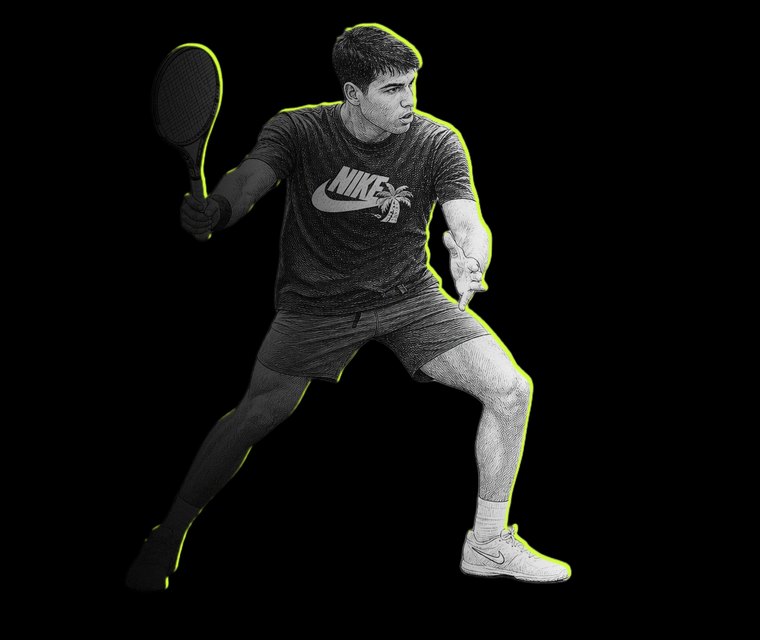
- 1The preparation looks like a forehand drive: racquet up and back, shoulders turned. That's the disguise.
- 2He then drops low into a long lunge and opens the face under the ball.
- 3The follow-through is short and under the ball, not the long finish of a drive.
Our own observations from the traced frames. Flip through the plate above to check them.
By the numbers
In charted matches from 2015 to March 2024, he dropped on 5.4 % of points and won 62.1 %, against 4.6 % and 53.8 % for the tour. His net gain, +6.5 points per 1,000, was the highest measured.
Jeff Sackmann, Tennis Abstract, Mar 2024Before his forehand drop, opponents stand 14.5 m from the net on average, against 12.9 m in other rallies. The shot before is hit at about 134 km/h, against his usual 113–115.
ATP, Feb 2023The advantage is mostly on the forehand drop: in charted matches he wins 66 % of forehand drops (tour 59 %) and 53 % of backhand drops (tour 52 %).
Match Charting Project, read Sep 2026When other players copied the forehand drop after his rise, their win rate on it fell from 52.4 % to 48.2 %.
ATP, Feb 2023
Madrid 2022
He won 59 of 77 points with the drop shot during the tournament, and opponents including Norrie and Jabeur have credited his disguise and his use of both wings.
Roland-Garros.com, May 2022What you can copy
Copy the setup, not just the drop. The data says the ball before it does the work: a hard, deep shot that pushes your opponent back, then the drop with the same preparation.
ATP, Feb 2023
What we don't claim
- A widely shared claim that he drops in 16 % of rallies conflicts with the charting data (5.4 % of points) and tracking data (3.1 % of shots). We don't use it.